Visiting a pearl farm
Tags: French Polynesia, Mangareva
Date: July 17, 2026
On our last full day in the Gambiers, we visited a pearl farm. Polynesian black pearls are French Polynesia’s largest export, and constitute over 55 percent of their annual exports. The pearl farms are located in the Tuamotu and Gambier archipelagos and the relatively cold waters in the Gambiers are well suited for the production of quality pearls. The Gambiers has over 100 farms and they contribute greatly to the relative prosperity and high employment rate in the Gambiers.
We went on a tour of the farm called Nanihi Pearl Product. The tour was led by Mohea, who co-owns the farm with her husband. We were picked up by a truck in town and taken to the western side of Mangareva and finally taken by boat to the farm. At the pearl farm headquarters we came off the boat next to the white hut below and walked across the narrow walkway:
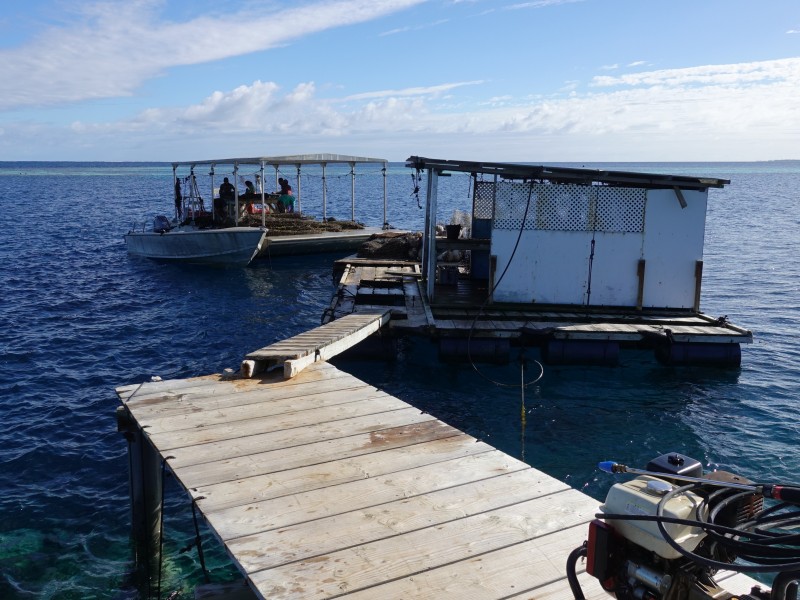
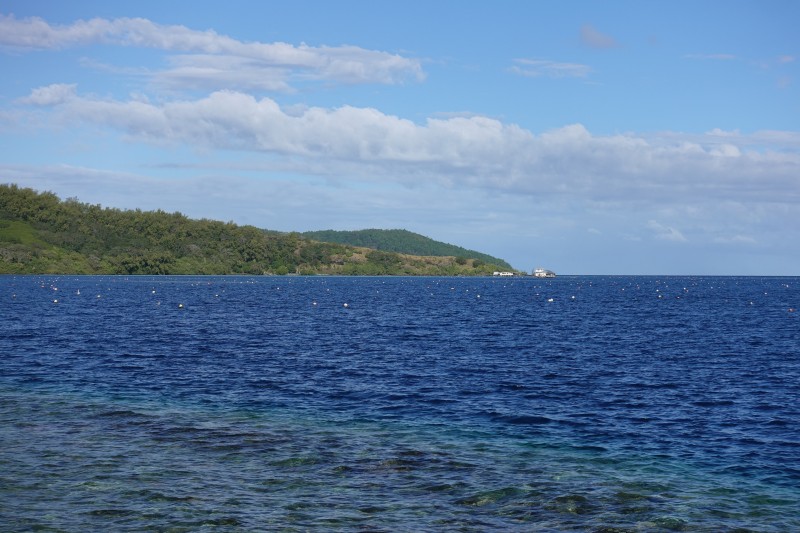
Here is a view over the lagoon from there. All the little white dots in the water are floats from which the pearl oysters at different stages of development and production are hanging on ropes or wrapped in nets:
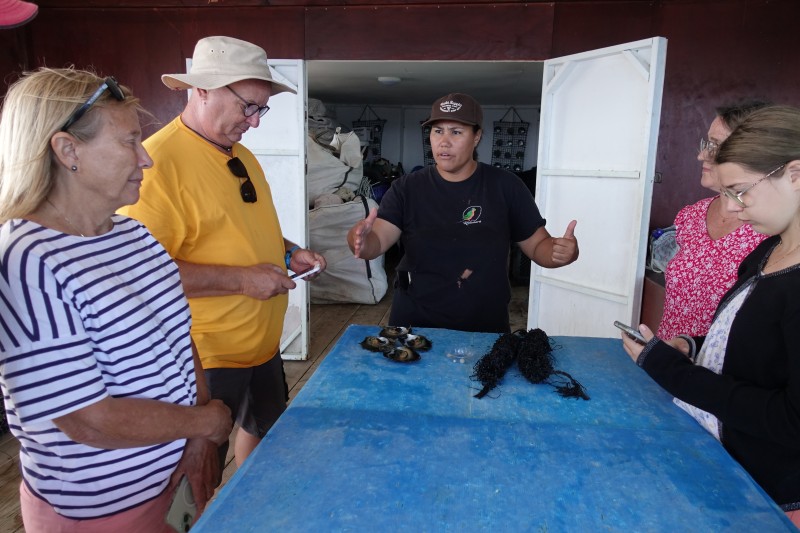
Here, we entered a larger building sitting on stilts in the middle of the lagoon and Mohea (in the cap and black t-shirt) started her demonstration:
Polynesian black pearls are formed by the black lip oyster (Pinctada margaritifera). The pearls are very rarely completely black but rather gray with various overtones of green, pink, blue or yellow. Truly black Polynesian pearls are extremely rare and valuable.
Cultivation starts by the collection of oyster larvae that hatch naturally in the waters around the Gambiers. This is done by lowering what looks like large plastic bottle brushes in the lagoon on the east side of Mangareva, where the majority of the black lip oysters hatch. The larvae attach themselves to the bottle brushes and grow there until they have formed a shell and are large enough to transfer from the bottle brush to a rope where they are tied through a small hole drilled into the shell.
Bottle brush device with pearl oysters ready for transfer to the rope:
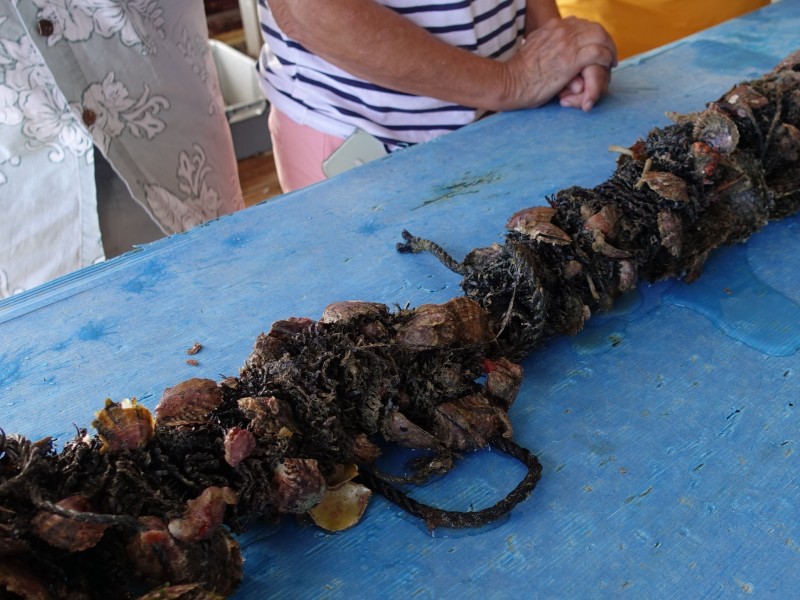
Bottle brush next to a rope with oysters large enough to graft the pearl nucleus:
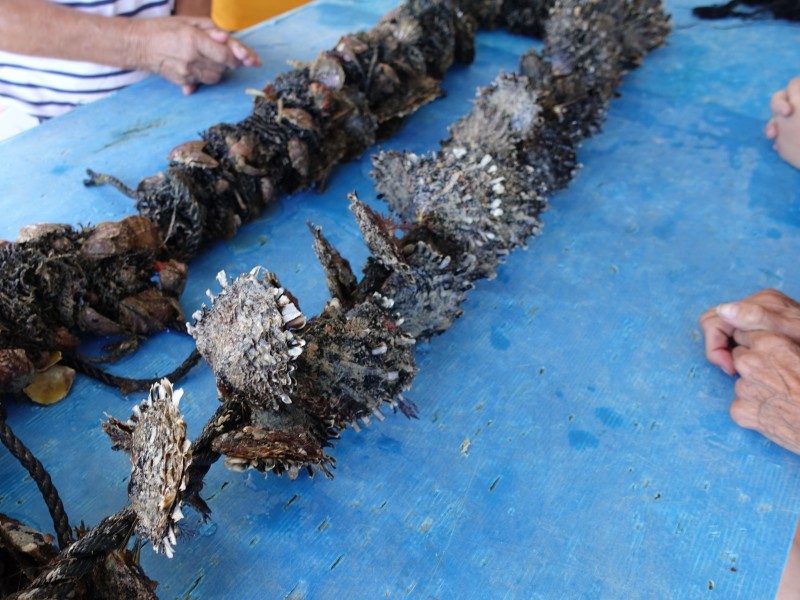
When the oysters from the rope have been grafted they are placed in little pockets of a net that is lowered into the lagoon and there they sit for 18 months while the pearl is formed on the nucleus:
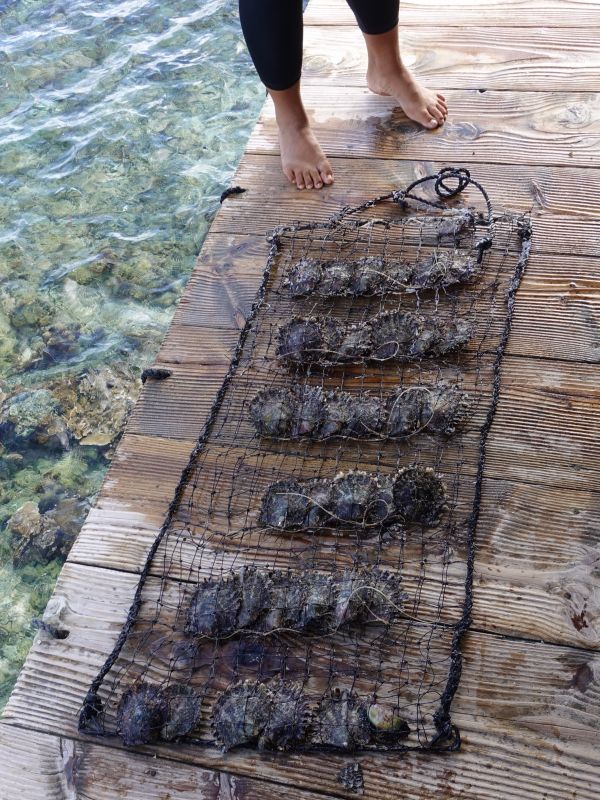
This is what the black pearl oyster looks like inside:
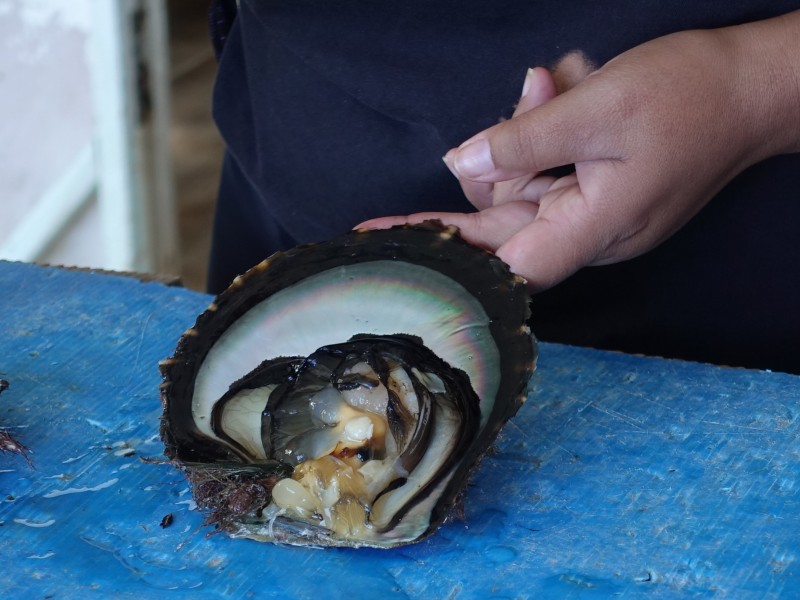
A natural pearl is formed when the mantle tissue of the oyster (the black tissue above) is injured e.g. by a parasite or a fish. In response to the injury, the mantle tissue secretes nacre aka mother-of-pearl into a cyst (called the pearl sac) that forms during the healing process. The nacre builds up in layers until it fills the pearl sac and eventually a pearl is formed. Cultured pearls, like the ones produced at the Polynesian pearl farms, are initiated by inserting a tissue graft from the mantle of a donor oyster into a recipient oyster, upon which a pearl sac forms, and the inner side precipitates nacre, just like when a natural pearl is formed. To speed up the process, a spherical bead (the pearl nucleus) is inserted during the grafting along with the donor tissue and the pearl is formed by layer upon layer of nacre being deposited around and covering the bead. This process was devised by the British marine biologist William Sackville-Kent in 1893 and commercialized with great success by Kokichi Mikimoto from Japan during the first part of the 20th century.
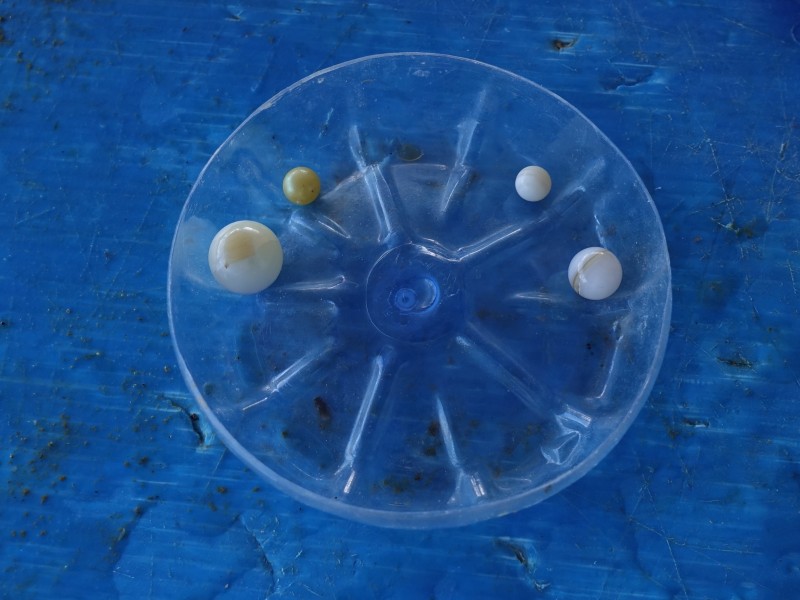
The beads are made from shells of freshwater river mussels harvested in the Mississippi River. Below are four pearl nuclei of different sizes:
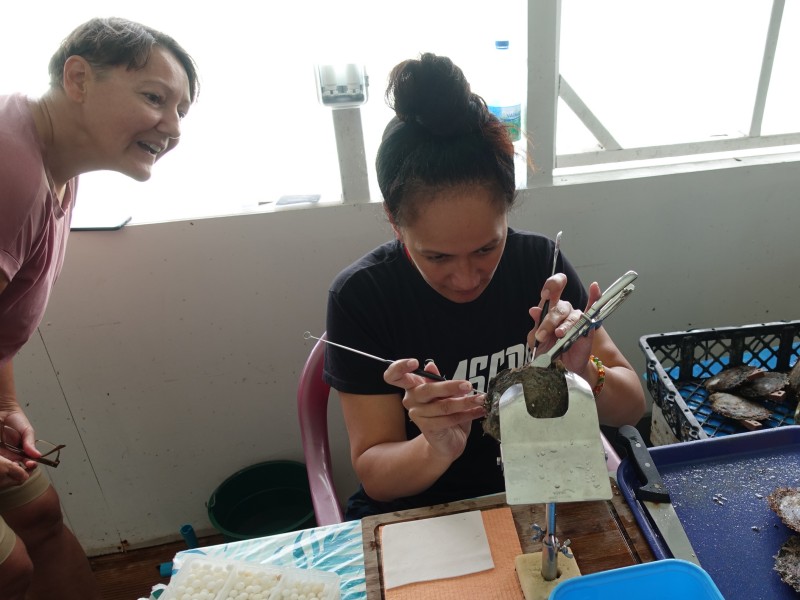
Here is one of the employees grafting oysters with donor mantle tissue and a pearl nucleus:
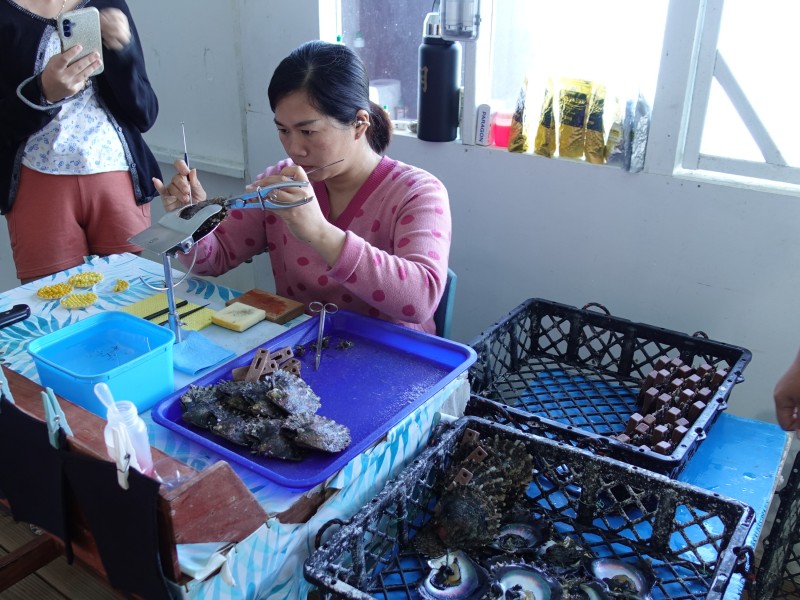
After grafting, the oyster goes back in the water inside one of the nets with pockets and sits there for 18 months during which time, if all goes well, the oyster will deposit layer upon layer of nacre around the pearl nucleus.
At the end of the demonstration we each got to choose an oyster to open and see if it contained a pearl, and we got to keep the pearl! Getting ready to open the oyster:
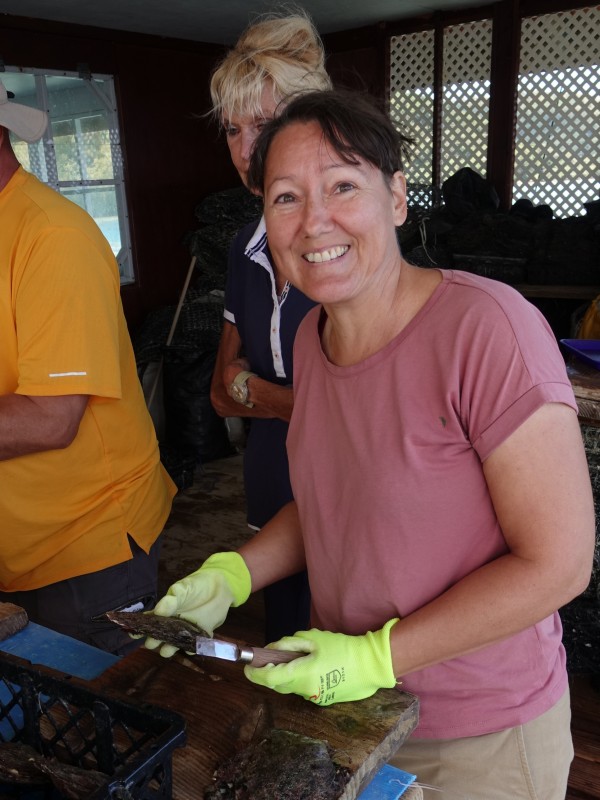
It's very exciting!
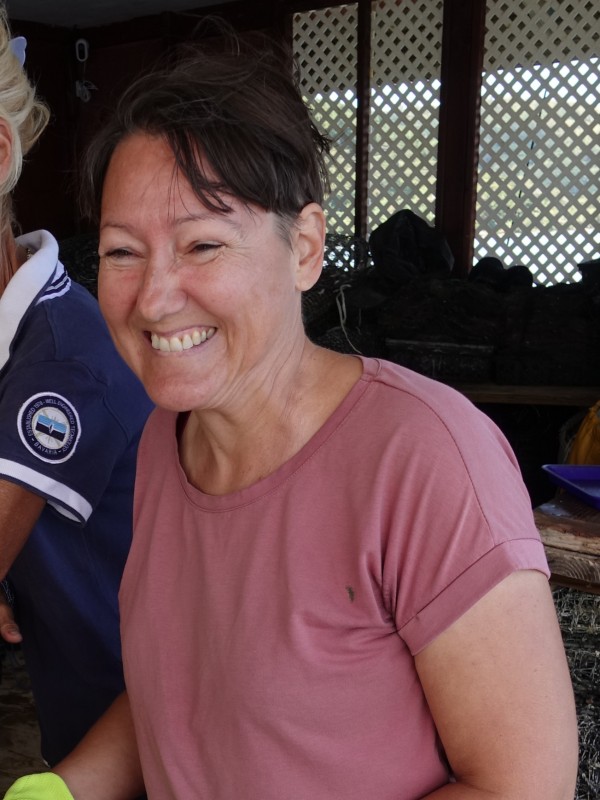
Mohea demonstrating where to insert the knife:
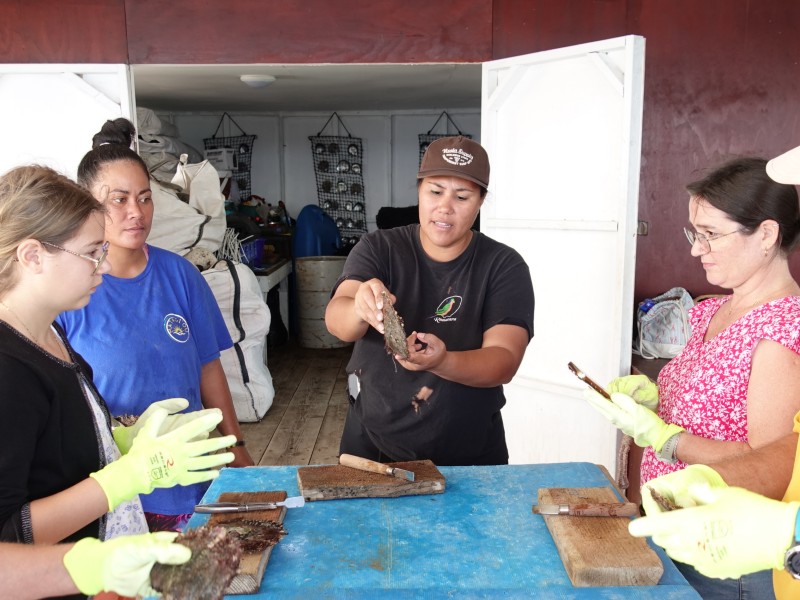
Then we went to work:
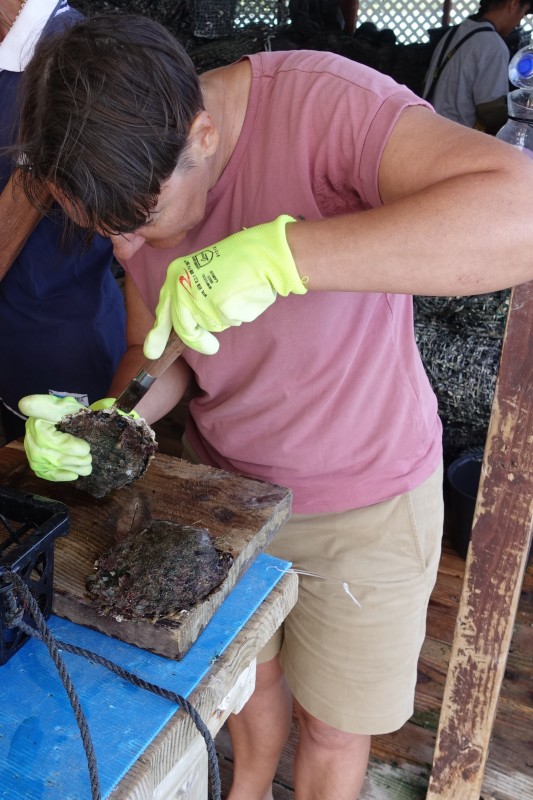
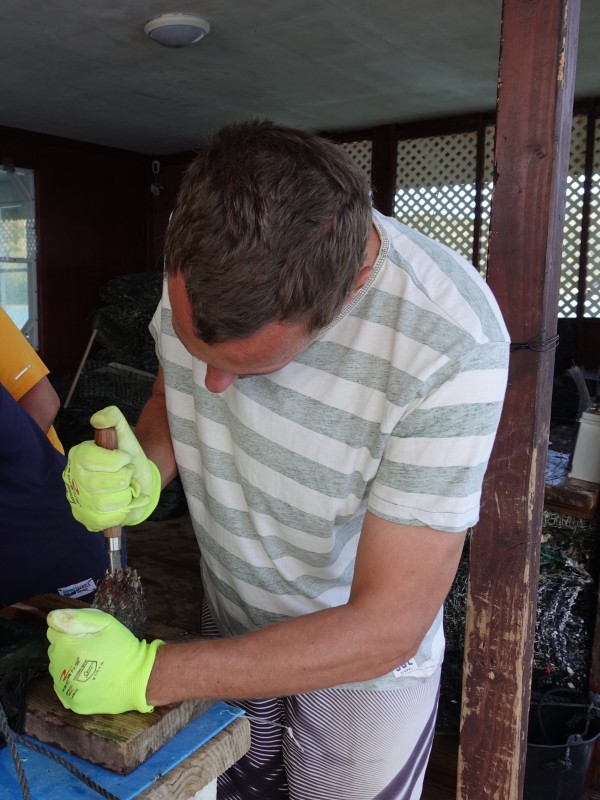
After using the knife to force the shell to open a bit we would place a plastic wedge in the opening to prevent the oyster from closing again after the knife was removed. Then we would bring the oyster to one of the grafters for her to extract the pearl without damaging the oyster and re-grafting it with a new nucleus:
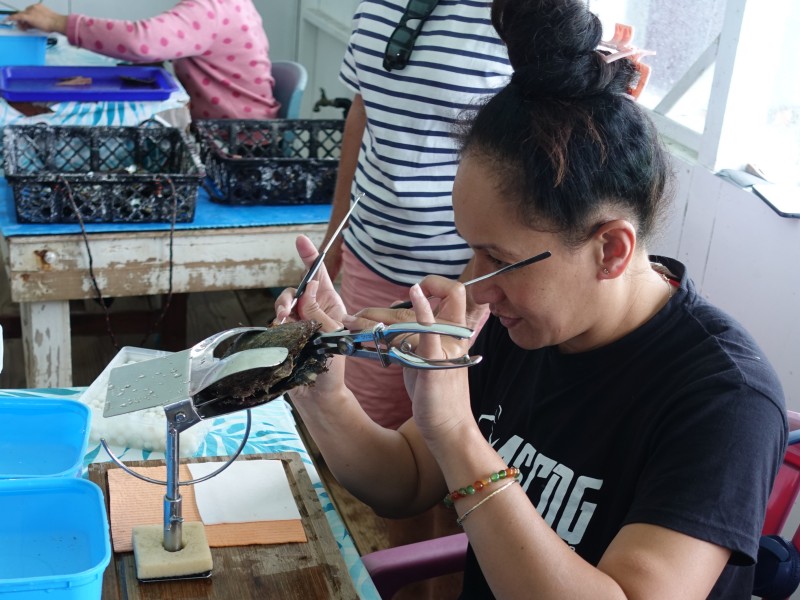
Felicie looking on as her pearl is being carefully extracted from the oyster:
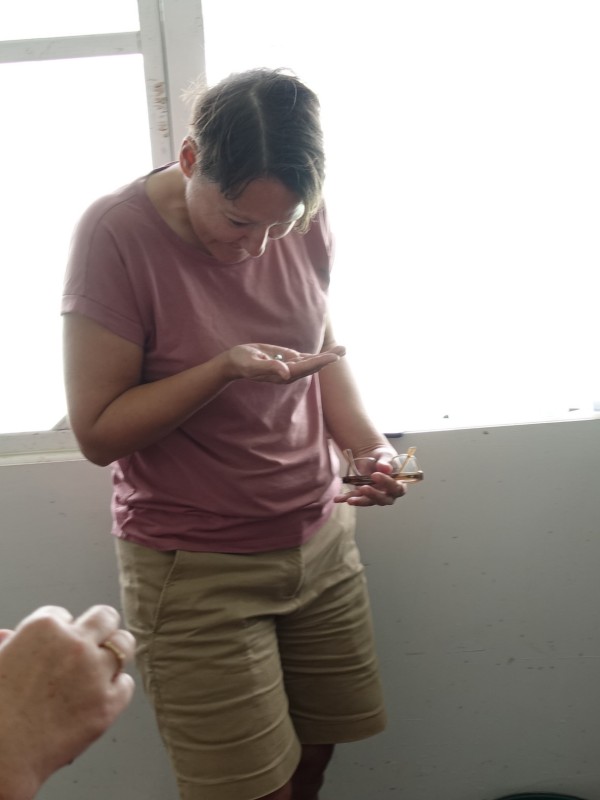
Felicie happily examining her pearl: